
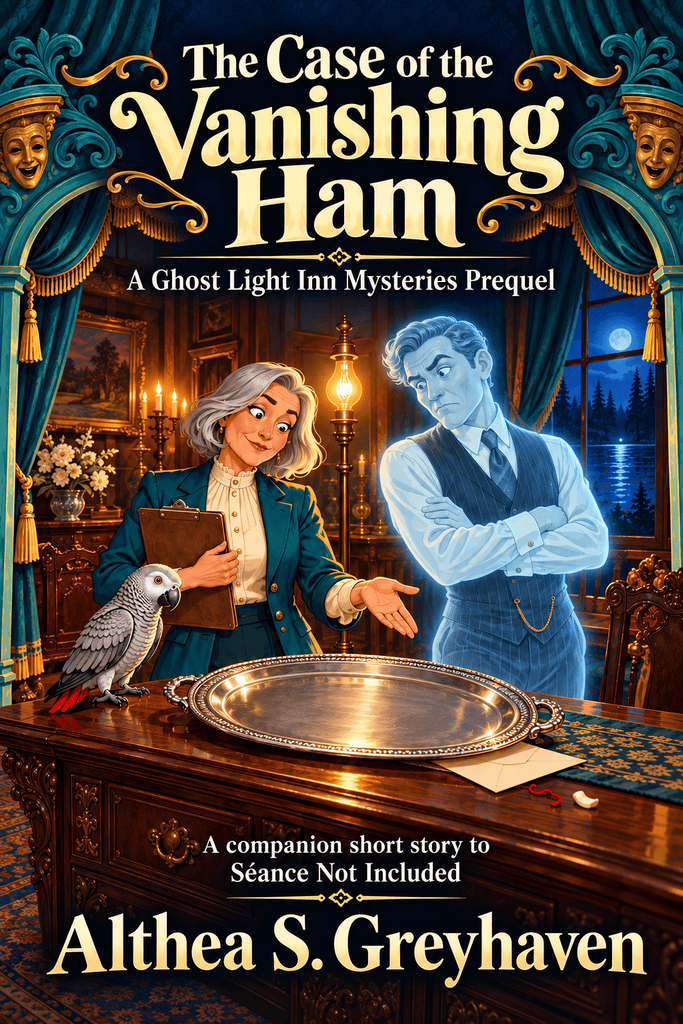
The Case of the Vanishing Ham
A missing ham. A sulking ghost. A troupe with something to hide.
Bets Fairweather expects a little drama at Larkmoor Inn’s murder mystery weekends—but investigating a vanished papier-mâché ham was never in the script.
With guests awaiting their next clue, her ghostly stage manager refusing to speak, and a parrot repeating things better left unsaid, Bets must uncover what happened before the afternoon’s performance.
*The Case of the Vanishing Ham* is a warm, witty prequel to *Séance Not Included*, introducing the eccentric company of the **Ghost Light Inn Mysteries**.
The Case of the Vanishing Ham
Bets Fairweather had spent thirty years in the theatre, and in all that time she had never imagined a ham might become the most troublesome member of her cast.
It was not even a real ham.
That, according to Aubrey Bellamy, was beside the point.
“It is a prop,” he said, standing beside the dining room sideboard with his arms folded. “Props have assigned positions. They do not wander about at the convenience of the actors.”
“Neither do most hams, Aubrey.”
“This one has a history.”
“This one has papier-mâché.”
“It is an exceptionally well-made piece of papier-mâché.”
Bets considered the object in question. The ham sat on a silver-colored platter, its glossy pink surface scored into perfect diamonds, each intersection decorated with a painted clove. At one end, an imitation bone protruded with a confidence that real bones rarely managed.
It looked magnificent from six feet away. From three feet, it looked like something a particularly ambitious child had made for a school pageant.
Bets had found it in a storage cupboard during her first week at Larkmoor Inn, tucked between a cardboard crown and a feathered hat that had apparently once belonged to an ostrich of considerable social standing.
Bellamy had nearly wept.
Or at least he had gone very quiet, which Bets had learned was the spectral equivalent of an emotional breakdown.
Aubrey Bellamy had been the inn’s stage manager in 1938 and, as far as Bets could tell, had never officially resigned. He remained at Larkmoor in the form of a transparent gentleman wearing a waistcoat and an expression of permanent professional disappointment.
Only Bets could see him, which was both a blessing and a considerable inconvenience.
Now, a month into her new career as an innkeeper, the ham had been promoted to a starring role in her latest murder-mystery weekend.
The Widow’s Last Supper was a suitably ridiculous production involving a wealthy widow, three suspicious relatives, an inheritance, and a dinner invitation nobody should have accepted.
The ham was central to the second-act puzzle. Beneath its platter lay a sealed envelope containing the clue that would expose the fictional murderer.
Without the ham, Bets could still conduct the mystery. Without the clue, she might have to refund six paying guests.
She found the first possibility irritating and the second personally offensive.
“Dev,” she called, “have you signed out the ham?”
Dev Mehta appeared from behind the dining room curtain, wearing a waistcoat and the expression of a man who had forgotten something important.
“Yes. Four forty-five yesterday. One imitation ham, one platter, one sealed envelope.”
“Good.”
“I wrote ‘artificial ham’ in the ledger.”
Bellamy made a small, wounded sound.
“Imitation,” he corrected.
“He can’t hear you,” Bets reminded him.
“He should know the difference.”
Dev looked from the ledger to Bets.
“Did you say something?”
“Only that the ham is in excellent hands.”
“Oh.” Dev smiled. “Thank you.”
“That was not what I said,” Bellamy protested.
Bets gave him the smile she reserved for directors who wished to change the ending during opening night. It was an effective smile. It had ended two marriages, three arguments with lighting designers, and one regrettable experiment with interpretive dance.
Bellamy disappeared through the dining room wall.
“Temperamental,” Bets murmured.
“Who?” asked Dev.
“The ham.”
***

Saturday morning arrived wearing a blanket of mist. Larkmoor Lake had vanished beyond the dock, leaving the inn apparently suspended in a great white nothing. Inside, however, the house was very much alive.
Odette Lund was arguing with a teapot. Lo Baptiste was arranging place cards. Dev was looking for a missing cufflink.
Cue, Bets’s African grey parrot, was conducting his own rehearsal from the library alcove.
“Absolutely not!” he announced in Odette’s throaty contralto.
“Darling, I said that once,” Odette called.
“Absolutely not!”
“You are becoming repetitive.”
“Absolutely not!”
Lo laughed so hard she nearly dropped the place cards.
Bets surveyed the scene with professional satisfaction. There was a certain beauty in chaos, provided it happened before the audience arrived.
Her six guests were finishing breakfast and preparing for the afternoon’s staged accusations. One of them, a retired schoolteacher named Mrs. Pritchard, had become particularly enthusiastic about the props.
“Wonderful ham,” she had declared over coffee. “Do you think it’s Victorian?”
“I think it’s indigestible,” Bets had replied.
Mrs. Pritchard had laughed and asked whether she might photograph it. Bets had agreed.
She had not yet learned that every apparently harmless permission granted to a paying guest could return later wearing a false moustache.
At half past ten, Bets entered the dining room to check the second-act arrangement.
The silver-colored platter remained on the sideboard. The sealed envelope was exactly where it belonged.
The ham was gone.
She stared at the empty platter, then looked underneath it. She inspected the sideboard, although she could not imagine how a ham might squeeze into a drawer without assistance.
Then she looked up.
“Bellamy?”
The ghost appeared by the curtains so quickly that she suspected he had been waiting.
His gaze moved to the platter.
His mouth opened.
It closed again.
“Oh, don’t start,” Bets said. “It’s a ham. We will find it.”
Bellamy’s expression developed the terrible stillness of a stage manager watching an actor carry a lit candle toward a velvet curtain.
“I know you’re upset,” Bets continued, “but nobody has died. Nobody has even been inconvenienced, except possibly the ham.”
Bellamy’s face darkened.
“Please don’t make this into a catastrophe.”
The ghost turned and walked straight through the wall.
Bets waited.
“Bellamy?”
Nothing.
“Aubrey?”
The room remained empty.
She sighed.
“Well,” she told the platter, “at least one of us has retained a sense of proportion.”
It was the beginning of a silence that would last nine days.
***
The investigation began badly.
Bets assembled her company in the dining room, where the empty platter occupied the sideboard with the accusation of a vacant leading role.
“Someone,” she announced, “has misplaced our ham.”
Dev immediately went pale.
“I signed it out.”
“Yes, darling.”
“I’m responsible.”
“You’re responsible for the ledger.”
“Bellamy is going to hate this.”
“He has already expressed a view.”
Odette leaned forward.
“Has someone taken the real ham?”
“There is no real ham,” Bets said.
“Then that’s one problem solved.”
Lo folded her arms.
“Did you check behind the curtains?”
“Yes.”
“The prop cupboard?”
“Yes.”
“The kitchen?”
“Twice.”
“Why twice?”
“Because the first time I discovered someone had labeled a tin of peaches ‘Emergency Blood’.”
“That was me,” said Dev.
“I assumed.”
Mrs. Pritchard appeared in the doorway.
“Oh! Are we investigating something?”
“No,” Bets said.
“Yes,” said Dev.
“Possibly,” said Lo.
Mrs. Pritchard clasped her hands.
“How exciting.”
Bets privately revised her opinion of paying guests. She invited the woman inside.
“Mrs. Pritchard, you photographed the ham earlier. Did you happen to move it?”
“Good heavens, no. I only took three photographs. Although I did notice something interesting.”
Bets straightened.
“What?”
“The bone looked rather loose.”
Dev made a noise. Odette looked at Lo, and Lo looked at the window.
Bets noticed all three reactions and disliked the way they arranged themselves.
“Loose how?”
“Wobbly,” said Mrs. Pritchard. “I thought it might be designed to come out. A hidden compartment, perhaps. Like one of those puzzle boxes.”
“There is no hidden compartment,” Dev said.
“Not in the ham,” Bets corrected. “Only beneath the platter.”
“Oh, I see. Well, I certainly didn’t touch it.” Mrs. Pritchard considered the empty silver surface. “Is it possible someone has eaten it?”
“No,” said Bets.
“Because that would be a very clever murder-mystery twist.”
“Only for a dentist.”
Mrs. Pritchard departed to share her theories with the other guests, leaving Bets alone with three performers who were suddenly displaying a remarkable interest in the dining room furnishings.
Bets turned back to her company.
“Right. Nobody leaves this room until I know where the ham went.”
Dev sat down.
Odette raised an eyebrow.
Lo checked the grandfather clock visible through the doorway.
Bets realized she had just trapped herself in a room with three performers who had considerably more experience than she did at waiting out a director.
It was going to be a long morning.
As it happened, actors were remarkably good at remaining seated when they wished to be difficult. Bets abandoned the threat after eleven minutes.
“Let us approach this logically,” she said. “Who last saw the ham?”
“I did,” Dev said. “At breakfast. I checked the sideboard before the guests came down.”
“Was it intact?”
“Yes.”
“Are you certain?”
“Mostly.”
“Dev.”
“The bone was a little crooked.”
Odette examined her fingernails. Lo became deeply interested in the curtains.
Bets made a note on her clipboard.
“Fine. Who went near the sideboard after breakfast?”
“Everyone,” said Odette. “It’s a dining room.”
“An excellent observation. Not especially helpful.”
“I brought in the silver tray.”
“When?”
“About ten.”
“And?”
“And I put it down.”
“Where?”
“On the sideboard.”
“Next to the ham?”
“Yes.”
“Did you move the ham?”
“No.”
It was a very convincing no.
Bets knew this because Odette had played forty-one murder victims on television and could make almost any declaration sound convincing, including the occasional statement about her age.
Lo coughed.
Odette looked at her.
The exchange lasted less than a second.
Bets wrote Odette / Lo — something on her clipboard.
“Very well,” she said. “I shall inspect the scene.”
***
There were three things on the sideboard that had not been there the previous evening.
The first was a small chip of ivory-colored paint. The second was a faint white powder. The third was a single strand of red thread.
Bets considered them.
“Interesting.”
From the library came Cue’s voice, this time in an imitation of Dev.
“I’m responsible!”
“Not helping, darling,” Bets called.
She bent closer to the ivory chip. It matched the painted bone.
The powder might have been flour, although Odette insisted that all her baking took place in the kitchen, where it could be properly appreciated.
The red thread was stranger. The imitation ham had no fabric on its exterior.
Bets picked up the strand and held it against the light. It was thin, glossy, and distinctly theatrical.
From somewhere behind the wall came the faint creak of old timber.
“Bellamy,” she said.
No reply.
“I know you’re listening.”
Still nothing.
“Would you care to identify this thread? You’ve spent most of the morning demonstrating how deeply you care about theatrical property.”
A slight movement caught her eye. For one instant she saw him standing in the doorway, transparent and disapproving.
Then he was gone again.
“Childish,” she muttered.
She looked back at the sideboard.
Something about the paint chip troubled her. If the ham had been stolen, why would there be damage? A person carrying an object away would normally pick it up. They wouldn’t need to break it first.
Unless it had been broken before anyone decided to take it.
She added a second note to her clipboard.
Accident?
The possibility improved her mood considerably.
Accidents were familiar. She had once opened a production of The Importance of Being Earnest with no handbag, a missing Algernon, and a leading lady who had mistaken furniture polish for hairspray.
The audience had given them a standing ovation.
Accidents could be managed.
It was secrecy that generally caused trouble.
***
At noon, Bets found Lo in the laundry room, folding sheets into immaculate rectangles.
Lo had carried mail for thirty years before retiring, and Bets had discovered that the habits of the postal service did not disappear merely because a person no longer wore the uniform.
Lo sorted everything. Towels by size, tea bags by flavor, bills by urgency.
Once, to Bets’s horror, she had arranged the library books by the height of their spines because the arrangement looked neater.
“Lo,” Bets said pleasantly.
“That tone never means anything good.”
“What tone?”
“The one you use before telling an actor they’ve been wonderful and then changing everything.”
Bets smiled.
“I wondered whether you’d seen anything unusual this morning.”
“I’ve seen Odette put salt in her coffee, Dev search for a cufflink he was already wearing, and a guest attempt to open the linen cupboard with his room key.”
“Anything involving a ham?”
“No.”
It came too quickly.
Bets knew about lines delivered too quickly. They generally belonged to actors who had been practicing.
“What are you folding?”
“Sheets.”
“And what is that?”
She pointed to a roll of brown wrapping paper beside the laundry basket.
“Wrapping paper,” Lo said.
“I recognize the species.”
“Then why ask?”
“Because I’m curious.”
Lo folded another sheet.
Bets watched her hands. On the third finger of Lo’s right hand was a spot of white paste.
It looked remarkably like the powder on the sideboard.
“Are you repairing something?”
“Always.”
“What?”
“This inn has three hundred things that need repairing, Bets.”
“Three hundred and one, apparently.”
Lo’s hands stopped for the smallest fraction of a second. Then she lifted the folded sheets and carried them toward the cupboard.
Bets allowed her to go.
Thirty years of directing had taught her that cornering a performer rarely produced the truth.
It merely produced a longer performance.
***
The breakthrough came from a bird who had no interest in justice and an extremely strong interest in crackers.
Cue was sitting on his perch in the library, examining the remains of a wooden toy.
Bets approached with a small piece of apple.
“Hello, darling.”
“Dinner is served!” he announced in Odette’s voice.
“Soon enough.”
“I’m responsible!” he said, in Dev’s.
“You have already made that point.”
Cue took the apple.
Then, very distinctly, in Lo’s voice, he said, “Don’t let her see it.”
Bets stopped.
“What?”
“Don’t let her see it,” Cue repeated.
It was unmistakably Lo. The low, practical voice. The clipped rhythm. Even the slight impatience at the end.
Bets felt the pleasant little thrill she remembered from rehearsal rooms, when the scattered pieces of a scene suddenly began to fit together.
“Who mustn’t see it, Cue?”
The parrot considered her.
“Absolutely not!” he said, as Odette.
“Yes, I thought you might say that.”
She went back to the dining room and looked at the sideboard again.
A painted bone, a chipped surface, white paste, red thread, and a woman with wrapping paper.
She now believed she knew who had removed the ham.
What she did not know was why.
And why, of all things, it had to be kept from her.
***
The answer was in the old ballroom.
Or rather, it was behind the ballroom, in a storage recess where the company kept the trunks used during rehearsals.
Bets had gone there looking for a substitute centerpiece.
She found three candlesticks, a collapsible sword, a wooden pineapple, and a parcel wrapped in brown paper.
It was approximately ham-shaped.
This seemed significant.
The parcel rested on a shelf behind a box of old costume jewelry. Someone had tied the wrapping with red thread.
Bets lifted it carefully.
A tiny flake of ivory-colored paint fell from one end.
“Oh, Lo,” she said.
She untied the thread.
Inside lay the missing ham.
It had suffered a dreadful injury.
A jagged crack ran along one side, and the painted bone had separated from the main body. Someone had made a careful attempt to repair it with paste and a strip of muslin, but the join had not held.
The ham looked as though it had survived a small but personally insulting explosion.
Bets stood looking at it for a moment.
She understood the accident.
She did not yet understand the lie.
“I had hoped,” said Lo from the doorway, “that you’d give me until Sunday.”
Bets turned.
Lo stood with her arms folded, looking thoroughly displeased with the situation.
“Sunday?”
“I know someone on the mainland who repairs theatrical things. Floats, masks, papier-mâché heads. She does lovely work.”
“So you planned to send the ham for repairs?”
“Yes.”
“Without telling me?”
“I was going to bring it back before the next weekend.”
“And if you couldn’t?”
Lo said nothing.
Bets put down the parcel.
“Lo.”
There was a long pause.
Then Lo sighed.
“Odette knocked it off the sideboard.”
Bets waited.
“She was carrying the silver tray, and the corner caught the platter. The ham rolled off. It struck the floor, and the bone came loose.”
“And you decided to hide it?”
“I decided to fix it.”
“Those are different activities.”
“Not always.”
Bets sat on the edge of a costume trunk.
“Why not simply tell me?”
Lo looked away.
For the first time all morning, the answer did not arrive immediately.
“Odette was embarrassed,” she said at last. “She thought you’d be angry. And Dev was already worried about everything going wrong. You know what he’s like. He thinks a missed cue means the end of civilization.”
“He gets that from Bellamy,” Bets murmured.
“From whom?”
“Never mind.”
Lo rubbed the paste from her finger.
“We’re all still learning this, Bets. Odette hasn’t worked this way in years. I’ve spent my whole life delivering other people’s letters, and now you’re asking me to wear feathers and shout about inheritances. Dev thinks he ought to know everything already.”
She looked at the parcel.
“I thought if I could put one small thing right without making a fuss, it might help.”
Bets was quiet.
Beyond the ballroom windows, the mist had begun to lift from the lake. A narrow line of blue water showed between the pines.
She knew that feeling.
The desperate wish to make something right before anyone noticed it had gone wrong.
She had built an entire theatrical career on variations of it.
And sometimes she had paid dearly for the effort.
“Lo,” she said, “if we only showed audiences productions in which nothing had ever gone wrong, there would be no theatre.”
Lo gave a reluctant smile.
“Does that mean you’re not angry?”
“I’m mildly furious that you made me investigate a ham.”
“Fair.”
“And I’m considerably more annoyed that you thought you couldn’t tell me you’d broken something.”
Lo looked down.
Bets lifted the parcel.
“We’ll send it for repairs on Sunday. Properly labeled. Properly recorded. And next time you break a prop, please tell me before I start questioning the paying guests.”
“Agreed.”
“One more thing.”
“Yes?”
“Why did Cue hear you say, ‘Don’t let her see it’?”
Lo looked mortified.
“Odette and I were talking by the library door. She said the ham looked like her third husband after a bad holiday. I told her not to let you see it until I’d done something about the crack.”
Bets stared at her.
Then she began to laugh.
She laughed until she had to sit down again.
Lo, who had never been particularly good at admitting she was funny, joined her.
By the time they stopped, Bets had decided that the afternoon performance might yet be saved.
***
The replacement ham was a fruitcake.
This was Odette’s idea.
“It has the correct shape,” she argued, setting the cake on the platter.
“It has raisins,” said Dev.
“Every family has raisins, darling. It’s no reason to cancel dinner.”
They covered the cake with a folded napkin and replaced the sealed clue envelope beneath the platter.
The six guests assembled in the dining room at four, full of anticipation and considerable quantities of shortbread.
Bets took her position near the door.
Bellamy was standing beside the fireplace.
She could see him clearly, although he continued to pretend she did not exist.
“Standing by,” she whispered.
He did not answer.
She raised two fingers.
The chandelier gave the slightest, most elegant shimmer.
Bets blinked.
She had not touched the switch.
The wiring in Larkmoor Inn was old, unreliable, and apparently developing a flair for timing.
She decided to investigate this at some future date when the ham was no longer missing.
“Places,” she murmured.
Odette swept into the room wearing a black gown and an expression of unbearable grief.
“My husband’s final supper,” she declared, indicating the covered platter.
Lo, playing the suspicious housekeeper, gave a magnificent gasp.
Dev produced an accusation with enough anguish to fill three drawing rooms.
The guests leaned forward.
Mrs. Pritchard was first to lift the napkin.
“A fruitcake!”
“Indeed,” Odette said. “My husband always insisted upon having the last word. It appears he has had the last raisin instead.”
There was a beat of perfect silence.
Then the room erupted in laughter.
Mrs. Pritchard discovered the envelope. Dev delivered his final speech, and the murderer was exposed, the inheritance restored, and the guests applauded as though they had witnessed something considerably more substantial than a disagreement over dessert.
Bets took her bow at the dining room door.
For once, everything had worked.
Everything except Aubrey Bellamy.
He stood by the mantelpiece with the expression of a man attending a funeral for proper procedure.
Bets leaned toward him.
“You must admit, the fruitcake was a triumph.”
Bellamy examined the ceiling.
“Fine,” she whispered. “Stay offended.”
He did.
***
The ham left Larkmoor on Sunday’s noon ferry, securely wrapped and addressed to the repairer Lo knew on the mainland.
Bets entered the damage in the prop ledger herself.
One imitation ham. Damaged. Sent for repair.
Bellamy watched her write.
He said nothing.
Over the following week, the inn returned to its usual rhythms. Dev rehearsed, Odette complained about the quality of theatrical wigs, and Lo reorganized the linen cupboard.
Cue discovered that the words “Absolutely not!” were especially effective when shouted at a passing tray of biscuits.
And Bellamy maintained his silence.
He appeared at rehearsals, inspected the props, and stood beside the staircase whenever Bets arranged the lanterns.
But he would not speak.
Bets tried apologies.
She tried compliments.
She tried threatening to replace the entire prop collection with inflatable furniture.
Nothing worked.
The ham returned on Friday’s ferry, beautifully restored, its surface repainted and the imitation bone once again fixed at its original angle.
Bets set it on the sideboard.
Bellamy inspected it for a full minute.
Then he vanished.
“Wonderful,” Bets told the empty room. “We’ve now offended the repair work.”
Saturday came and went. Another group of guests solved another entirely fictitious murder.
The ham performed flawlessly.
Bellamy remained silent.
By Sunday evening, Bets had begun to find his refusal almost restful, which alarmed her more than anything else.
On Monday morning, nine days after the disappearance, she went into the little stage manager’s office beneath the stairs.
The battered green prop ledger lay open on the desk.
She turned to the page containing the ham’s original entry.
Beside Sent for repair, she added:
Returned. Restored. Inspected. Ready for next performance.
Then, after a moment, she wrote another line.
All props to be checked for damage before and after use. Accidents to be reported immediately.
She put down her pencil.
“I’m sorry, Aubrey.”
The room was silent.
“I know it wasn’t only a ham.”
She glanced at the rows of careful entries, the years of theatrical objects accounted for in a handwriting that had somehow survived longer than the hand that made it.
“You spent a lifetime making certain things were where they ought to be. I shouldn’t have treated that as foolish.”
The lamp on the desk flickered once.
Bets looked up.
Bellamy stood on the other side of the desk, hands clasped behind his back.
He studied the ledger.
Then, at last, he spoke.
“You have spelled imitation correctly.”
Bets closed her eyes.
“Nine days.”
“Yes.”
“Nine days, Aubrey.”
“I considered ten.”
“For a ham.”
“For the principle.”
She looked at him.
He looked at her.
Then, very slowly, his stern expression softened.
“The repair is competent,” he allowed.
“High praise.”
“The replacement cake was not.”
“The guests loved it.”
“The guests are not qualified to judge theatrical authenticity.”
“Neither are most critics, in my experience.”
Bellamy considered this.
“True,” he said.
And then, with enormous reluctance, he smiled.
It was a tiny smile, barely more than a movement at the corner of his mouth, but it was enough.
Bets smiled back.
“Shall we call a truce?”
“Provided the ham remains in its assigned position.”
“Of course.”
“And the platter is properly centered.”
“Certainly.”
“And someone corrects Dev’s handwriting in the ledger.”
“Aubrey.”
“His sevens resemble ones. It is a disgrace.”
Bets laughed.
From the library came Cue’s voice, perfectly imitating Odette.
“Absolutely not!”
Bellamy looked toward the door.
“That bird,” he said, “has terrible timing.”
“No,” Bets replied, rising from the desk. “I think his timing is rather good.”
She passed into the lobby, where the morning light lay across the polished floorboards and the old inn creaked companionably around her.
There were lanterns to check, guests to confirm, and a new mystery weekend to prepare.
Somewhere in the dining room, a papier-mâché ham sat in splendid, immovable dignity upon its platter.
And for the first time in nine days, Larkmoor Inn’s stage manager was back at work.
Which, Bets reflected, was both a blessing and a considerable inconvenience.
THE END
**The ham was only the beginning…**

Enjoyed your stay at Larkmoor Inn? Bets, Bellamy, and Cue have another mystery waiting—and this time, the body is real.

In *Séance Not Included*, a murder mystery weekend takes a deadly turn when the critic whose review helped ruin Bets Fairweather’s theatre is found dead in the conservatory. With a motive everyone knows about, Bets must clear her name before her fresh start becomes her final act.

Her allies? An opinionated ghostly stage manager and a parrot who hears far too much. Her suspects? Guests who may be giving the performances of their lives.

Return to Larkmoor for theatrical humour, hidden secrets, and a murder nobody rehearsed.

**Get your copy of *Séance Not Included*—Book 1 of the Ghost Light Inn Mysteries—and let the next mystery begin.**